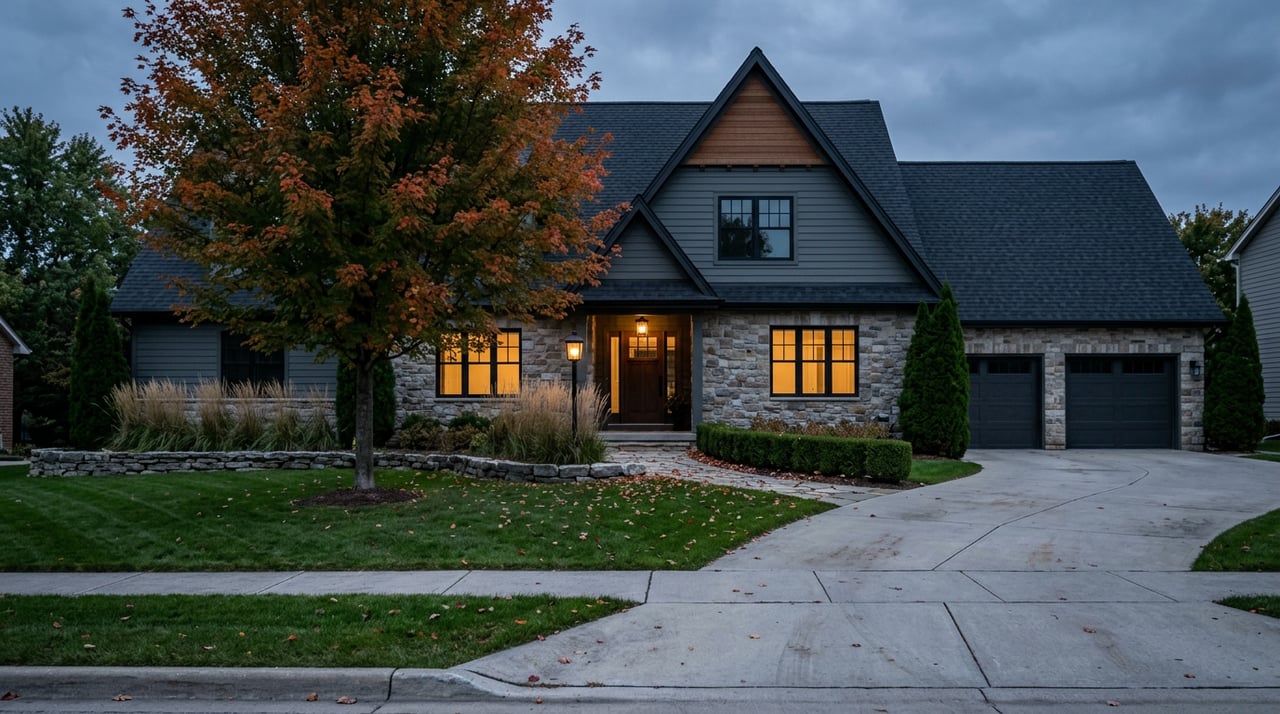
The tax bill arrives about ten months after closing, usually in December, and it has a line on it that never came up during the walkthrough. It says SID, followed by a district number, followed by a dollar figure that wasn't in any of the mortgage paperwork. For a lot of new-construction buyers in Bennington, this is the first time they've heard the term, and by then the house is already theirs.
Most explainers stop at defining the term. That's a start, but it skips the part that actually determines what a buyer pays: not whether a subdivision sits inside a Sanitary and Improvement District, but how far along that district is in paying off the debt that built it. Two homes in two different Bennington subdivisions can both carry a SID and still land on very different tax bills, because one district might be a year into a twenty-five-year bond and the other might be paid off next spring.
What A SID Actually Is In Nebraska
A Sanitary and Improvement District, or SID, is a unit of local government unique to Nebraska. When a developer wants to build a subdivision on land that isn't yet inside a city, someone has to pay for the roads, sewer lines, water mains, and street lighting before anyone can build a house. Nebraska handles this by letting the developer form a SID, which issues bonds to cover that infrastructure up front. Once families move in, the homeowners repay those bonds through an annual levy that shows up as a line item on the property tax bill, separate from city, county, and school district taxes. The Nebraska Legislature's statute on sanitary and improvement districts lays out exactly what a SID is authorized to build and finance, from streets and sewer systems to parks and street lighting.
A SID is not a homeowners association. Move to Omaha explains that a subdivision can have both at once, and paying one doesn't reduce or replace the other. The HOA governs shared amenities and covenants. The SID is a public taxing entity with bonds to retire.
Bennington Is Building Fast, And Most Of It Sits Inside A SID
Drive through Bennington's newer streets right now and you're mostly looking at SID-financed ground. Majestic Pointe, set along 168th and State Street next to a new NRD lake and recreation area, is being built out in three phases with 250 lots. Chestnut Hills, Hanover Falls, Newport Hill, Pine Creek, and Summer Hill Farm all show up in the current list of active Bennington subdivisions. Morgan Ridge, a 69-acre parcel near 168th and Military Road, was rezoned from agricultural to medium-density residential in late 2024 to make way for roughly 130 new lots.
The newest of these is Prairie Ridge. In July 2026, the Bennington City Council approved an ordinance platting the subdivision, formerly known as Bennington Park Plaza, into 54 residential lots plus outlots, with a mixed-use overlay attached. That means Prairie Ridge's SID, if and when one is formed for it, would be starting essentially from zero. No bond has aged. No principal has been retired. Whatever infrastructure debt gets issued to build those streets and utilities will sit at its most expensive point in the repayment schedule right when the first buyers close.
The Real Variable Isn't Whether. It's Where In The Bond.
This is the part that gets lost in generic SID explainers. A district that formed fifteen years ago and is fifteen years into a twenty-five-year bond behaves nothing like a district that broke ground last quarter. As homes fill in, as assessed values rise, and as the original construction debt gets paid down year over year, the levy needed to service that debt can shrink, sometimes substantially, well before the bond is fully retired. A brand-new SID has none of that history. It's carrying the full weight of a freshly issued bond against a small and still-growing tax base, which is often when the levy is highest relative to what a homeowner is actually getting for it.
Industry guides covering the Omaha metro describe SID levies ranging anywhere from a few hundred dollars a year to more than eight thousand, spread across a repayment window that typically runs two to three decades. Where a specific Bennington subdivision falls in that range depends entirely on the age of its district, not on the fact that a SID exists.
A SID is not a fixed cost. It's a moving one, and the direction it's moving depends on how many years are left on the bond.
That's why a buyer comparing a resale home in an established Bennington neighborhood to a new build in Prairie Ridge or a newer phase of Majestic Pointe isn't just comparing square footage and finishes. They're comparing two very different points on a debt-repayment timeline, even if both properties technically sit inside a SID.
What's Happening Right Now Near 180th And Military
There's a reason this matters more in Bennington this year than it might have a few years ago. In March 2025, Bennington Public Schools voters approved a $112 million bond by a 71 percent margin to fund a second high school on property near 180th Street and Military Road. That fall, the school board approved a series of infrastructure agreements needed to move the project forward, including a roadway construction and maintenance agreement with Douglas County and a separate interlocal cooperation agreement between Douglas County and SID 625 to cost-share roadway improvements along 180th Street.
That agreement doesn't tell a buyer what any specific levy will be. What it does show is that the infrastructure obligations tied to this corner of Bennington are actively expanding, not sitting still. A new high school means new road capacity, new utility runs, and new coordination between the school district, the county, and the SID that serves that ground. For anyone touring new construction near that corridor, it's a signal to ask specifically what's already committed and what might still be coming, rather than assuming the levy quoted today is the whole picture five years from now.
How SID Age Changes What A Buyer Is Actually Signing Up For
| Stage of the SID | What's typically true | What it means for a buyer |
|---|---|---|
| Newly formed (first few years) | Full bond principal outstanding, small and growing tax base | Levy is often at its highest relative to the home's value, with the longest runway still ahead |
| Mid-repayment (10 to 15 years in) | Tax base has matured, some principal retired | Levy has often started to ease, but new infrastructure agreements can add obligations |
| Near payoff or annexed | Bond close to retirement, or district has merged into the city | Levy may drop noticeably, though annexation doesn't erase every existing assessment |
Five Questions Before You Sign
- What is the current SID levy rate for this specific lot, not just the subdivision generally
- How many years remain on the bond, and when was the district originally formed
- Has the SID entered into any recent cost-sharing or infrastructure agreements, similar to the SID 625 roadway agreement tied to the new high school
- Is annexation into the City of Bennington anticipated for this district, and on what timeline
- What does the full estimated tax bill look like once city, county, school, and SID levies are added together
A builder or listing agent who can answer these clearly, with numbers rather than reassurance, is telling a buyer something useful about the property itself.
A Few Common Questions
Is a SID the same as an HOA? No. An HOA is a private organization that manages covenants and shared amenities. A SID is a public taxing district created to finance infrastructure. A property can be inside both at the same time, and paying one doesn't reduce what's owed on the other.
What happens to existing assessments after annexation? Annexation doesn't automatically erase every existing assessment tied to improvements that were already authorized, so it's worth asking what specifically changes rather than assuming a clean break.
How do I find the SID number and levy rate for a specific address in Bennington? The Douglas County Assessor's records and the property's most recent tax statement will list the SID by number if one applies. For homes still in the building phase, the builder or the SID's own board minutes are usually the most direct source for current levy figures.
Bennington's growth is bringing genuinely good things with it, from new parks to a second high school that will ease crowding across the district. None of that changes the math a buyer needs to do before writing an offer. Knowing whether a subdivision's SID is one year old or twenty makes the difference between a rough estimate and an actual number.
If you're comparing new construction in Bennington's newest subdivisions against resale homes elsewhere in the metro, the Staci Mueller Group can pull the specific SID details, levy history, and repayment stage for any property you're considering, so the number on your first tax bill is one you already expected.
This article is general information, not legal, tax or financial advice. Consult a qualified professional about your situation.
